


I had no idea, growing up as a Christian-thinking, mainstream, and popular young man in the great state of Oklahoma during the 1960s and most of the 1970s, that I would end up living a life so completely at odds with American culture. Yet that is what happened, and I am writing to tell you how it all came about.
I think modern culture changed more than I did. In the 1960s, it reached a point of no return and began moving against a society that had once been oriented toward Christianity. As a young man, it never crossed my mind that my country—and the civilization from which it was born—would detour at hyperspace speed into the cold, secularist, anti-Christian, and even Eastern-oriented culture in which it sadly glories today.
I did make a turn of my own, but in the opposite direction: toward a dogmatic religion so often despised by the secular world, Roman Catholicism. I was called to it by people outside my circle of childhood friends and acquaintances—people now outside time and space, whom we call saints. I did not come to it through my own merit. These great heavenly friends have led me peacefully to freedom as a whole, reintegrated person, with authentic faith, true reason, real hope, and a glimmer of God’s love.
Their call has also given me a sense of belonging and unity through Catholic Tradition with the great Christian civilization now almost dead: Christendom. Its high point was in the Middle Ages, and it formed the foundation of the culture I knew as a child. This book tells the story of my journey in the heart toward the culture of ancient Christendom and, spiritually, toward its edifying, metaphoric extension—the mystical Kingdom of God—through the truth of Catholic doctrine and dogma.
If modern culture is making you physically, mentally, and spiritually ill through its selfish, mean-spirited, and shallow lifestyles, along with its even shallower Eastern New Age spirituality, then you should read this book. Yet even if you love modern culture and its superficial Eastern spiritual solutions, you should still read it, though you probably will not like it. Even if these words have no more effect on the world than shooting a bubble gun at a charging elephant, I believe I need to speak them. According to G.K. Chesterton, this obtuseness of mine—what some may call “divisiveness”—might just be an indication that I am truly alive!
“A dead thing can go with the stream, but only a living thing can go against it.” (Everlasting Man)
Still, in one sense, I would describe my situation differently from the one in that quotation from Mr. Chesterton. I could say that, at a certain point in my life, I stepped onto a rock—a rock that does not move, a rock that is two thousand years old, and a rock whose foundation predates the physical universe. This is a very solid rock indeed. I would not want you to think that I am merely a reactionary, or that I embraced Catholicism only as a reaction against the rising tide of secularism. You will soon find out that I am very much a conformist, perhaps one of the most conforming people you have ever met. I conform to Catholic dogma as a drowning man wraps his arms around a solid rock sitting firmly above the water. Discovering the Rock of Truth in Catholicism and holding firmly to it against the hurricane-force winds of modern thought have resurrected my life. You are already beginning to sense what I mean by this obtuseness.

This story is written in the language of my heart. If everyone has a story that could benefit at least one other person, then this writing represents my story. It is the outcome of my spiritual journey through the life-saving and authentic world of the dogmas, creeds, traditions, and Scriptures of the two-thousand-year-old Roman Catholic Church. It is not intended to be a scholarly work, though it touches on many spiritual, theological, and philosophical subjects. To some, these words may sound like sweet music. To others, they may sound like fingernails scraping down a blackboard. To still others, they may seem like a muddled jumble of thoughts. I pray that no person of goodwill will be offended by my words, and that many will be edified.
Although this writing often reflects the subjective language of the heart, that should not obscure its central principle: the spiritual journey I will discuss with you has been, and is now being, taken along an objectively real path. By this I mean that the path is real and available to every person on earth, even though my description of it is subjective and based on my own experience.
This is truly important. If you think this story is simply about a special experience that is purely relative and subjective, then you have missed the point, and I will have proved myself the poorest of communicators. On the contrary, I hope you will follow the same path and have your own personal experience, grounded in shared, objective Truth. We can be united through objective Truth and still grow into the individuals God intended each of us to be, all by following the path of the dogmatic Roman Catholic Church. It is glorious! Only God could have conceived and founded this path, and I will show you that He did. The Catholic Church is not “man-made” religion; it is a visible institution founded by a “God-man.” That difference changes lives!
Here is an analogy: when you travel with another person, you both move along the same road, objectively speaking, even though each of you may describe the trip from your own subjective experience. You may describe different scenes or highlight different events. You will have different experiences, but you are traveling the same road.
This is an important point to keep in mind as you read this book. Many people today view everything as purely subjective; they assume that there can be no objectively Right Path for the world to follow. No one is supposed to say that objective truth exists—truth that can speak dogmatically about right and wrong, about how to reach heaven, and about how to avoid hell. Least of all should anyone dare to defend the idea that their path is the true one!
Well, I am going to do just that. I will not say that your personal experience along this path must be like mine. I will say, however, that the path itself—whatever your subjective experience of it may be—is the true road to freedom, joy, and eternal happiness. Jesus Christ teaches this through the Scriptures, the Sacred Traditions, and the magisterial teaching authority of His two-thousand-year-old Church. This path is true and solid ground.
My journey has taken place on this glorious path of Catholic dogma, which I call the Trail of the Dogmatic Creed. The Church has handed it down in direct Apostolic succession from the original twelve apostles. It is the only real road to which, I believe, true reason will lead you, and countless people before me have traveled it in freedom and joy. By God’s will, all people are called to travel it, for it is the only way to reach our ultimate destiny, which lies far beyond the material world of suffering we share as human beings. The God who wills us to travel this road opened it for us. He is a Father who wants all His children to find their way out of the wilderness that puzzles us each day when we arise. He has given us His very Son to lead us out of the Dark Forest.
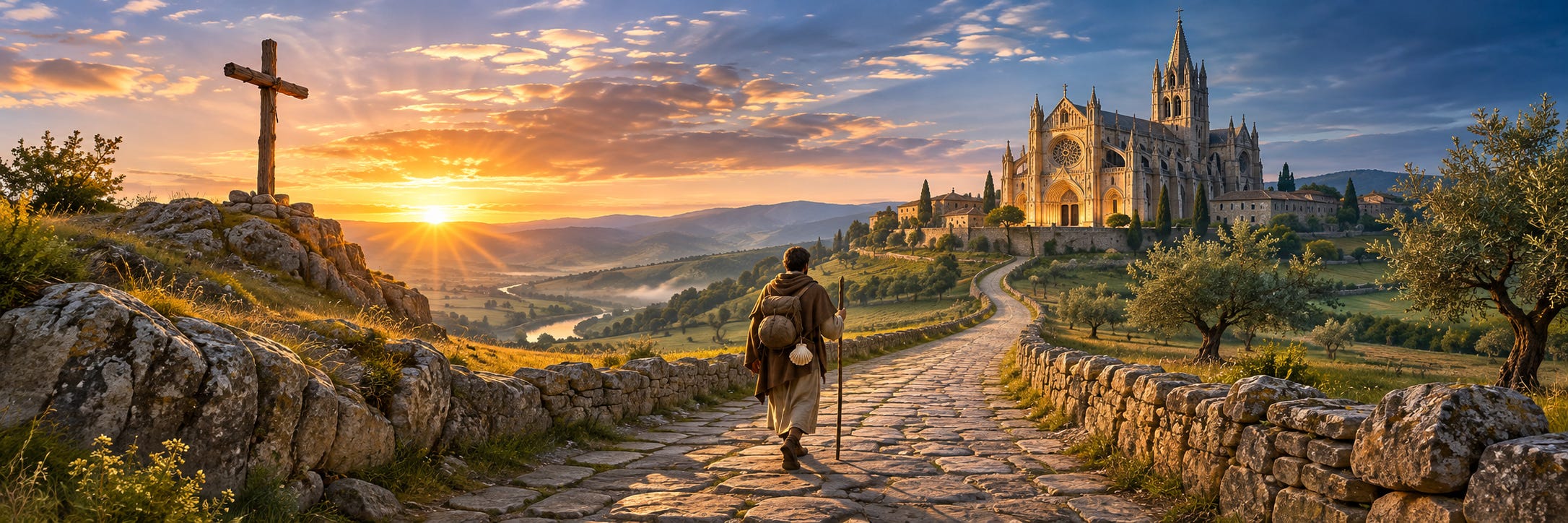
It saddens me more than anything that so many do not choose to follow this path, for they choose not to follow the will of the Good God. They are free to make that choice. The radical freedom that the atheist, the Eastern New Ager, or even the general secularist wishes to experience has already been given to them by God, though they usually do not understand this. God has given mankind the radical freedom to accept or reject Him. It is too bad that so many do not use that freedom to obey rather than disobey. For it is the free act of obedience to God that makes eternal beatitude an objective reality. We know this through God’s promise. Rejecting God in exchange for an inauthentic, godless freedom ultimately enslaves mankind. I know this from my own experience to be an objective reality!
Jesus Christ, the only Son of God, opened this saving path for us. He was brutally beaten and crucified by the nonbelievers of His day. Though He had the power to prevent it, He did not raise a finger to stop them, so that we might have the opportunity to travel this path of freedom with Him. He rose from the dead in real, physical, objective terms, as many witnesses testified. By His Holy Spirit, He inaugurated an institutional Church—the Roman Catholic Church—as His true body on earth. Through it, He could walk with mankind in every generation until all who are willing to accept the way are brought home.
He wishes every person to accept it. That is why we must preach and insist upon this great Gospel, the Good News of Jesus Christ, even in the face of a beautiful-sounding yet superficial, godless humanism that speaks of love for mankind but demonstrates hatred toward God and those who insist on obeying Him.
The atheistic or secular humanist speaks with righteous indignation about morality and opening our hearts to universal love, while insisting that Christianity embodies only intolerant hatred. G.K. Chesterton brilliantly sums up the hypocrisy of these humanists who “accept all religions” except, of course, Christianity, and most notably the Catholic Church:
“There are those who hate Christianity, and call their hatred an all-embracing love for all religions.”
As for atheistic, New Age, and secular humanism in general, notwithstanding its misguided attack on Christianity, the words of Our Lord might also come to mind. He asked what good it would do for a man to gain the whole world if he lost his soul in the process. (Mk 8:36)
It is enough to say that any humanism that rejects Christ cannot last; it is, as I have said, superficial. Christ rose from the dead; there is no other. Should we not pay attention to Him? What rational person could reject a resurrected Christ? What godless humanism makes sense in light of the resurrection? Mull that over for a while, and if you are, in fact, a person of true Reason, you will not need to read any further, for you will have grasped the key message: Christ is the objective reality! He is life! Why do we waste time with so many empty words and useless arguments in favor of a world without Him? It is nonsensical and deadly to do so.
One might argue that, in apparent contrast to what I am saying, organized and institutional religion is demonstrably dangerous, since it seems to be at the heart of many deadly wars. Yet religion has caused so much bloodshed because the eternal destination of our souls is something for which we should be willing to fight! We should be more willing to fight for our religion than for our country, because that would be more rational. Our ancestors in ancient Christendom knew this well. Tell me I must sell my soul and reject my Catholic religion for atheism or a blasphemous one-world spirituality, and I am ready to fight! I want to go to heaven, and I have no intention of letting you stop me. On this matter, I agree with G.K. Chesterton that religious war, though undesirable, is far more rational than wars between nations:
“The Crusade was a religious movement, but it was also a perfectly rational movement; one might almost say a rationalist movement...But it certainly is the fact that religious war is in itself much more rational than patriotic war. I for one have often defended and even encouraged patriotic war, and should always be ready to defend and encourage patriotic passion. But it cannot be denied that there is more of mere passion, of mere preference and prejudice, in short of mere personal accident, in fighting another nation than in fighting another faith. The Crusader is in every sense more rational than the modern conscript or professional soldier. He is more rational in his object, which is the intelligent and intelligible object of conversion; where the modern militarist has an object much more confused by momentary vanity and one-sided satisfaction.” (The Meaning of the Crusade)
Yet while I am fighting, I will try to convert my enemy, even though he is my enemy, for love—not warfare—drives the Catholic religion. We are divisive because we are contradictory, but we are so for love’s sake. I will explain all of this to you in this book!
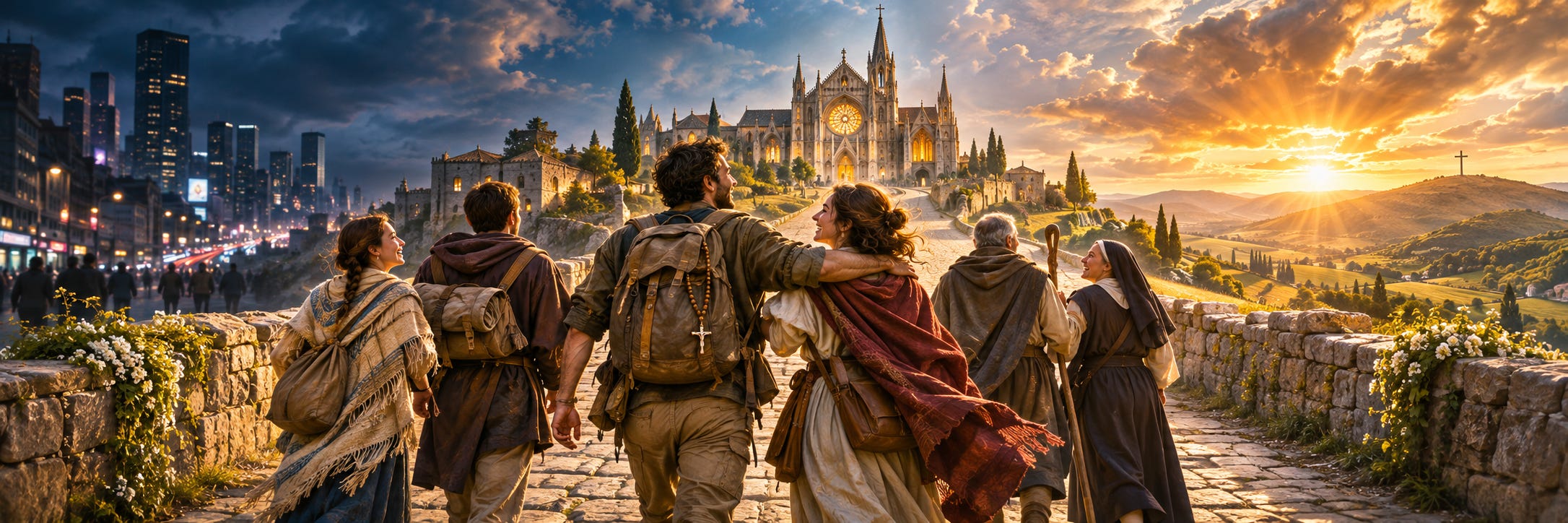
In discussing my subjective experience on this objective path to freedom, I truly want to present an age-old alternative to the depressing, deterministic, and oppressive worldview that chokes humanity today through either atheistic humanism or inauthentic and deceptive Eastern New Age spiritualism.
Alongside the growth of godless humanism nurtured by atheism, the Western world has spent several generations under significant Eastern Hindu and Buddhist influence. As a result, the true Western mind, represented by Roman Catholicism for most of the past two thousand years, has all but disappeared.
We are so lost in the idea that individuals can create a subjective Christ of their own meaning within their own consciences, apart from any objectively speaking institution—even one that can be historically validated as founded by Christ Himself—that we have ended up with non-Christian, Eastern New Age philosophers writing books to teach us about Christ! Heaven save us!
The modern mind can no longer conceive of anything beyond relativistic morality, the denial of dogmatic certainties, or the belief that no one can really know the truth. These are all Eastern intrusions upon the Truth of Christ’s own concrete, dogmatic teachings to the contrary. Those with Eastern spiritual orientations who dare to write about Christ as if He were a Hindu or Buddhist, a source of “enlightenment,” are spreading darkness rather than enlightenment. In fact, they have no authority to teach this nonsense. The authority to teach about Christ rests in the very Church He personally and historically founded, which has held the treasuries of the Faith for over two thousand years!
“In order that the full and living Gospel might always be preserved in the Church the apostles left Bishops as their successors. They gave them ‘their own position of teaching authority.” (Catechism of the Catholic Church, paragraph 77)
“The task of giving an authentic interpretation of the Word of God, whether in its written form or in the form of Tradition, has been entrusted to the living, teaching office of the Church alone. Its authority in this matter is exercised in the name of Jesus Christ. This means that the task of interpretation has been entrusted to the bishops in communion with the successor of Peter, the Bishop of Rome.” (Catechism of the Catholic Church, paragraph 85)
The very idea that I can tell an Eastern thinker he has no authority to teach about Christ is itself incomprehensible to the modern mind. Statements like that will send it reeling. That is how deeply Eastern “subjective” and “non-judgmental” thought has sunk its claws into the Western world. For the first fifteen hundred years of Christianity, before Protestantism raged through the Continent of Europe and opened the philosophical door to skepticism about revealed Truth, this was not so. You know the old question: if God seems far away, who moved? Well, if Christianity in the West seems far removed from its traditional base, I ask: who moved? It was not the Roman Catholic Church, which has maintained a real, material Apostolic succession from the time of Christ and therefore holds the authority to teach the message taught by the original Apostles.
Although my motivation for writing about this journey is driven by a desire to share the source of Truth and encourage others to walk this path, it is driven further by my love for mankind.
Society drones on, mindlessly addicted to constant noise and distraction: twenty-four-hour news, trashy sitcoms, and internet surfing. Meanwhile, an aristocratic few manipulate exchange markets, declare wars, and outlaw anything resembling the morality of the old empire of Christendom. The other day, I happened to see a sidebar news item about a mall shooting in the Northwest. Just another day in the Western world! Such things are now almost routinely accepted and rarely recognized for the true horrors they are. No, we enjoy making popcorn and watching live video of shootings on television. The same society that condemns Christianity for the Crusades is quick to abdicate responsibility for children shooting other children in schools and for similar tragedies—or even for the killing of millions of babies through abortion.
Society is indeed like an addict in denial. Appeasing the addict by avoiding anything that might sound “judgmental,” or by “loving” him with beautiful-sounding, godless humanism and allowing him to continue his addiction, does not work. You have to take away the addictive drugs and offer him a real, healthy alternative to the way he is living. Regular participation in the Church’s sacraments, more silence and solitude in a spirit of prayer, better education in the Faith of Our Fathers, the practice of virtue, and even a sacrifice such as fasting—these activities will restore health to mind and body. They are life-giving alternatives to the soul pollution of our new, improved, “progressive” world! These are the alternatives offered today by the institutional Roman Catholic Church and the very solutions it has offered for over two thousand years.
Saving souls—that is real love. That is what Jesus Christ did. He did far more than “enlighten” us. He saved us from the deadly effects of original sin, and no Eastern spirituality or atheistic humanism can do that. To ignore Christ’s work while merely saying lovely things that sound sweet is only “killing me softly with his words,” as an old pop song goes. Attraction is always a better route than promotion, in my mind, but when the addict is very sick, there comes a time when straight talk is all you have to get his attention. Straight talk out of love is my true operating principle, because the addict—our society—is out of control and dying.
Most of all, I hope that those who read this book will choose to join me and multitudes of others in joyfully dancing and playing along this great and noble path to freedom. In fact, I call it The Freedom Dance, because those who called me to it were dancing joyfully themselves.
This vision of dancing joyfully along a path of Catholic dogma is a great challenge to the modern mind, which wastes its time in self-seeking psychotherapy sessions, hoping to be affirmed in its own subjective and wishful thinking. Whatever little time remains is spent going to the pharmacist or liquor store for another month’s worth of “get-me-bys.” This mind will not confess to a priest, but it will spend thousands of dollars confessing to a therapist. “Psychoanalysis is confession without absolution,” said G. K. Chesterton. Yet we are called silly because we dance freely along the path of Catholic dogma. I pray that these others will one day join us.
I care about only one response: that nothing in this writing be opposed to the teachings of Holy Mother Church. My desire is to please Our Lord and Our Lady and to remain in complete union with the Pope and the magisterial teachings of the Church.
As you will soon discover if you decide to read this, I care nothing for the opinion of any man, save that of Jesus Christ, the Son of God, who died on that old wooden Cross for the redemption of the world. He is the Founder of the Roman Catholic Church, through whom all things were created, and there is no other.
It will be before the Founder of the Roman Catholic Church, the builder of Western Civilization, that all Powers, all Kings, all Presidents, all Court Justices, all Legislators, all Journalists, all Finance Ministers, all of Hollywood—indeed, every person on earth—will kneel, and there is no other. “And he shall judge the Gentiles and rebuke many people.” (Isaiah 2:4a; Douay-Rheims) He is the Mediator with the Father in heaven, and there is no other.
Finally, I desire to please that sweet and holy Lady, the Mother of Our Lord and therefore the Mother of God. She has brought me from darkness into the light that is her Son.
