

One of the most profound tragedies of our modern era is the dominance of a non-divine and erroneous dogma: moral and religious relativism. Under this dogma, one may no longer defend a belief, much less a religion. If no one can truly know the truth, and no religion may therefore claim to possess it, then “defending” one’s belief in the public square or in cultural debates is treated as naively and arrogantly “forcing one’s personal beliefs” on others. To virtually everyone one meets walking down the street—including, sadly, the vast majority of Catholics in America—the propositions above are sacrosanct and beyond repudiation. This is, after all, what “freedom” is all about, n’est-ce pas?
What inevitably goes unrecognized in this dialogue is that a society’s culture reflects its beliefs. There may be “separation of Church and State” (whatever that really means), but there cannot be “separation of Church and Culture.” What people believe shapes how they act and how they see the world. When people with shared actions and worldviews associate with one another, they shape the culture of their society in the public realm.
The culture of ancient Christendom reflected God because its people believed in God. Modern culture reflects the vulgarity and blasphemy of self-worship because modern people believe in themselves. To tell religious people to stay out of public view is to reflect the dominance of a secular, atheistic worldview antagonistic to religion. Such a society is neither “neutral” nor “free.” One worldview is dominating another, as is always the case. There is no escaping it.
Thus, to be told to “keep one’s religious views to oneself” in public discussion is to be told that anti-religion must serve as the dogmatic facilitator of public debate. For a religious person to agree is simply to surrender the battle—and even one’s faith.
Western Civilization was built by the Catholic Church. The glories, grandeur, intellectual development, sciences, philosophies, art, and architecture of the West were grounded in a Catholic worldview. Western civilization is a Catholic civilization. To agree to “keep one’s religion to one’s self” and to “keep religion out of the public debate” is to surrender all of Western Civilization to the non-divine dogma of secularism. In other words, it is the end of civilization as we know it.
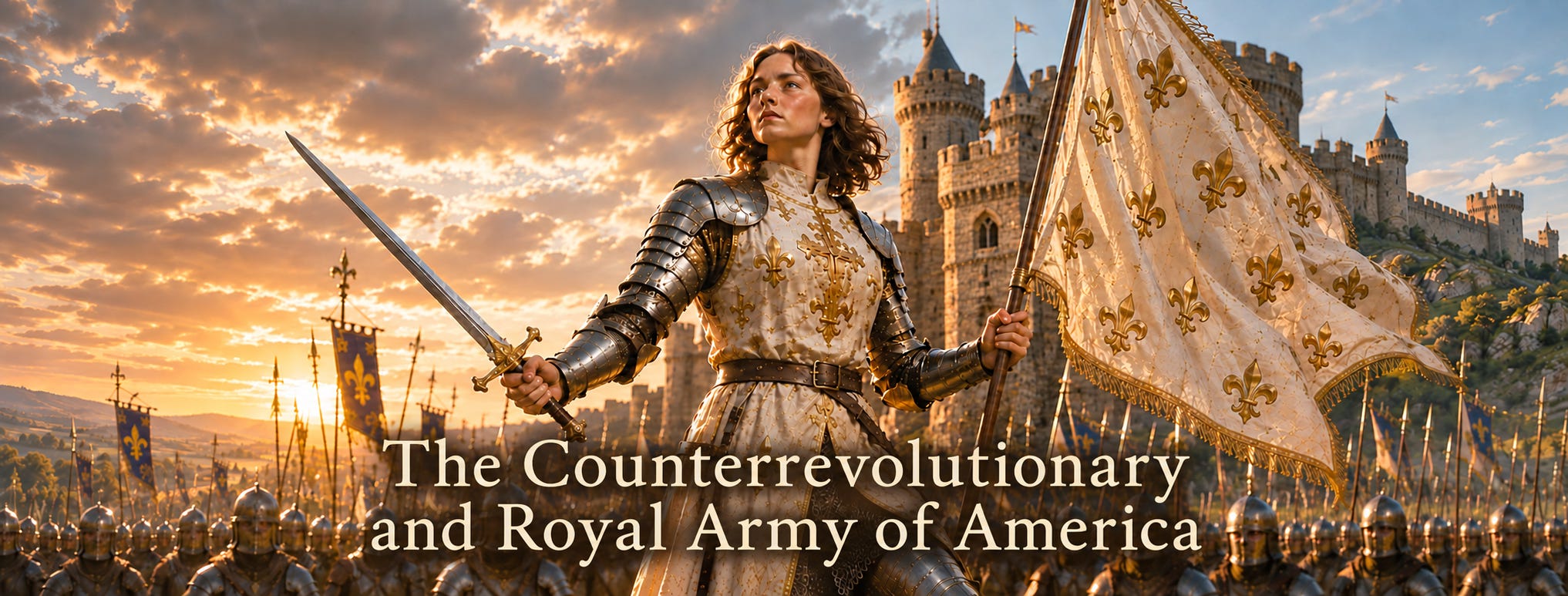
The Counterrevolutionary and Royal Army of America (CRAA) is a call for organized political, social, and cultural resistance to the unlawful and blasphemous occupation of our land—and of Western Civilization generally—by the impious and vulgar secular atheists. It is a call for a counterrevolution: to upend and overturn the primordial Revolution against man and the Kingdom of God, a revolution that is nothing more than spiritual anarchy and a new Dark Age. The CRAA is inspired by the Armée Catholique et Royale of the Bocage Vendée region of France during the French Revolution, whose people fought valiantly against the atheistic Revolution and for their faith, their Church, and their Monarchy.
The CRAA was conceived and designed both to propagate and to defend Le Royaume, the Mystical Kingdom of France, which is nothing less than a manifestation of the Kingdom of God. Le Royaume celebrates the mystical relationship between the Kingdom of Heaven and the Kingdom of France. In a mysterious way, as The 10 Points of Le Royaume suggest, this mystical Kingdom encompasses not only France but also the culture and life of all Western Civilization, including The United States of America. There, we understand the deep spiritual connection between the Kingdom of France and America, along with the great need for the mystical Kingdom of France to destroy heresies and restore Catholic preeminence in religion, spirituality, culture, and politics to our dying civilization.
Welcome to the Counterrevolution.
“As for the Church, I love her and would wish to sustain her with all my power for our Christian faith... And I am of the opinion that it is all one and the same thing, God and the Church, and that of that one should make no difficulty. Why do you make difficulty over that?”
- St. Joan of Arc, at her trial of condemnation